Posts

Showing posts with the label Stem Cell

Utilizing Single Cells To Get the Whole Picture of the Epigenetic

Image
Genes may control what qualities are passed down from parent to posterity, but every cell expresses these genes distinctively dependent on “external” epigenetic modifications.   Epigenetics doesn't adjust the quality arrangement (genotype), however, they do impact cell behavior and function (phenotype). The study of epigenetics helps us see how phenotypic changes lead to malady, stem cell differentiation, and essentially, what drives the fate of every cell in the human body. The epigenome isn't reliable between cells, or even between cells of a similar sort. Individual changes travel every which way all through a cell's lifetime. In this way, researchers are confronted with the precarious test as they attempt to the role of epigenetics in infection and development. Understanding intercellular heterogeneity is key here. The epigenome must be inspected at single-cell resolution. Now with the advancement of single-cell sequencing strategies like the single...

Nanotechnology Platform Could Improve Stem Cell Transplantation?

Image
Stem cells can grow into many non-identical kinds of cells, including neurons that transmit information within the brain. Adult human-induced pluripotent stem cells, which resemble embryonic stem cells , are often used to develop drugs and model diseases. While stem cells hold great potential for treating neurodegenerative diseases and central nervous system injuries, controlling and characterizing their fate are critical issues that need to be addressed before their potential use as treatments is often fully realized. Current methods for characterizing stem cell biomarkers destroy cellular activities and functions, which makes it difficult to conduct more definitive research that might cause biomedical applications. Using their nanotechnology platform, the scientists successfully monitored the generation of neurons from human stem cells by characterizing next-generation biomarkers called exosomes—tiny particles released by cells that play a critical role in cell-to-cel...

Could Stem Cells Help Corona virus Disease COVID-19 Patients?

Image
Patients who were dealt with while in a serious condition have been released after recuperation. Stem cells can self-renew or multiply while maintaining the potential to become other sorts of cells. They can become cells of the blood, heart, lungs or other body parts.  Stem cells even have a strong function, advancing the formation of the newest blood vessels, cell proliferation, and differentiation and inhibiting inflammatory response, experts say. Stem cell therapy has been utilized in the treatment of some infectious diseases and complications. For instance, it's been tried in treating H7N9 avian flu and showed good results. Human and animal studies have shown that after infection with coronavirus, the rapid replication of the virus in the body and the subsequent inflammatory response cause damage to alveolar epithelial cells and capillary endothelial cells, causing diffuse interstitial and alveolar edema, and pulmonary function. Impaired, leading to acute hy...

Now Is The Time For You To Know About Stem Cell Therapy For Coronavirus Infection

Image
While this treatment isn't a technique to destroy or fix Coronavirus, there is proof to help the idea that tainted patients might be bound to battle and endure the contamination. To start with, undifferentiated organisms oppose viral assault by the statement of specific qualities known as interferon-gamma invigorated qualities (ISGs). These are communicated in undeveloped cells before their separation. Thus, foundational microorganisms would be required to endure regardless of whether transplanted into a patient with a functioning Coronavirus disease. Likewise, it is realized that undeveloped cells revive and recover cells in the body through different procedures including a decrease of aggravation, emission of substances that secure cells, move of mitochondria, decrease of cell passing, hostile to oxidative impacts and improvement of resistant framework work. These impacts are probably going to build endurance in patients tainted with Coronavirus. Likewise, there is imm...

Meet the Excellent Women Scientist at StemGen 2020

Image
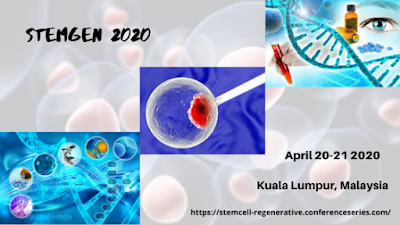
The greater aim is to bring women scientists to the forefront by enhancing their visibility. Scientific strategies include basic biology of all adult stem cells, early and late translational research, developing gene-editing technology for possible therapeutic applications, creation of animal models for various human diseases and training programs on the various components of stem cells and regenerative medicine. Stem Cell and Regenerative Medicine (StemGen 2020), which will be held during April 20-21, 2020 carrying the theme as 'Stem Cells: Innovations and Applications’ in Kuala Lumpur, Malaysia. StemGen 2020 warmly welcomes the researchers and developers, professionals who are studying or analyzing in the fields of Genetics , Stem Cell, Regenerative Medicine , Cell Biology, etc., and other associated organizations to participate in the event and grasp knowledge about the recent researches regarding stem cell and regenerative medicine and their analysis. This confere...

What is stem cell and regenerative medicine and how does It work ?

Image
. Stem Cell An undifferentiated organism is a cell with the exceptional capacity to form into specific cell types in the body. Later on, they might be utilized to supplant cells and tissues that have been harmed or lost because of the malady. Uses of Stem Cell In undeveloped cell transplants , immature microorganisms supplant cells harmed by chemotherapy or sickness or fill in as a route for the benefactor's resistant framework to battle a few kinds of malignant growth and blood-related infections, for example, leukemia, lymphoma, neuroblastoma, and various myelomas. These transplants utilize grown-up undifferentiated cells or umbilical line blood. How do we get stem cells? Grown-up undifferentiated cells can be confined from the body in various manners, contingent upon the tissue. Blood undifferentiated cells, for instance, can be taken from a benefactor's bone marrow, from blood in the umbilical string when a child is conceived, or from an individual'...

Stem Cells: Innovations and Applications

Image
13th International Conference on Stem Cell and Regenerative Medicine   is a two-day conference which will be held during April 20-21, 2020 in Kuala Lumpur Malaysia. Which embraces apt keynote presentations, Oral talks, Poster presentations and Exhibitions? The theme of the conference is “Stem Cells: Innovations and Applications” This will be an inordinate platform to gather and share knowledge, presentations, panel discussions, interactive dialogue about the developing world of StemGen. Our target audience includes: Stem Cell Developers and Investigators, Gene Therapy Researchers, Genetic Scientist, Regenerative Medicine Researchers, Cell biologist, Academic Professionals, Anatomical Researchers, Oncologists, Neurologists, Immunologists, Ophthalmologists, Pharmaceutical Industry professionals, Business Entrepreneurs, Drug Manufacturing Companies. The researchers and developers, professionals who are studying or analyzing in the fields of Stem Cell, Genetics, Regenerati...